Brand associations in AI answers: which words AI attaches to you
Cheap, enterprise-only, hard to set up: the words AI engines attach to a brand travel from their sources. How we find those associations, score them, and shift them.
Take a project-management tool we'll call Acme. Ask five AI engines about it and the answers differ in length, structure, and which competitors they mention. But three phrases keep coming back: "easy to start with", "best for small teams", and "limited reporting". Nobody at Acme chose those phrases. They are now the brand, as far as a buyer asking ChatGPT or Perplexity is concerned.
Those recurring phrases are what we mean by brand associations in AI answers. They're the adjectives and short descriptions an engine reliably attaches to your name, and they do more to shape a buyer's first impression than any tagline you wrote. This post covers how to find them, how to read their tone, why they're sticky, and what we do to change the ones that hurt.
Associations are not the same as mentions
A mention means your name is in the answer. An association is what comes with it. Two brands can have identical visibility and completely different associations: one is "the reliable default", the other "cheaper, but expect bugs". Visibility metrics treat them the same. Buyers don't.
Associations also differ from overall sentiment. A sentiment score tells you the tone of an answer toward you on balance. Associations tell you the specific reasons. An average of 62 doesn't help a product marketer decide what to fix. Knowing that engines praise your onboarding and doubt your reporting does.
The associations we look for first
Across categories, the same handful of association types do most of the damage, or most of the good:
- Audience labels: "enterprise-only", "for freelancers", "aimed at developers". These quietly disqualify buyers who don't fit the label.
- Price labels: "cheap", "premium", "good value", "pricey for what you get". Price framing travels further than actual prices.
- Effort labels: "hard to set up", "plug and play", "requires a developer".
- Gap labels: "lacks a mobile app", "limited integrations". Often true once, sometimes still repeated after the gap was closed.
- Reputation labels: "the go-to choice", "a newer option", "well reviewed".
An association can be accurate and still worth working on. "Best for small teams" is a fine label for a product built for small teams. It's a problem for one that just launched an enterprise tier.
How we find them at scale
Asking engines yourself and highlighting phrases works for a few prompts. It falls apart across hundreds of tracked prompts and six or more engines, which is the scale where associations become visible as patterns rather than anecdotes.
Brand Narrative in Promptwatch, the platform we run client programs on, is the tool we use for this. It reads every tracked response that names a tracked brand, yours or a competitor's, and extracts each claim with the exact sentence it came from. Claims have to be verbatim quotes of at least four words, and the brand has to be named. When different responses make the same point in different words, they're grouped into one claim, with counts showing how often engines repeat it and which models say it.
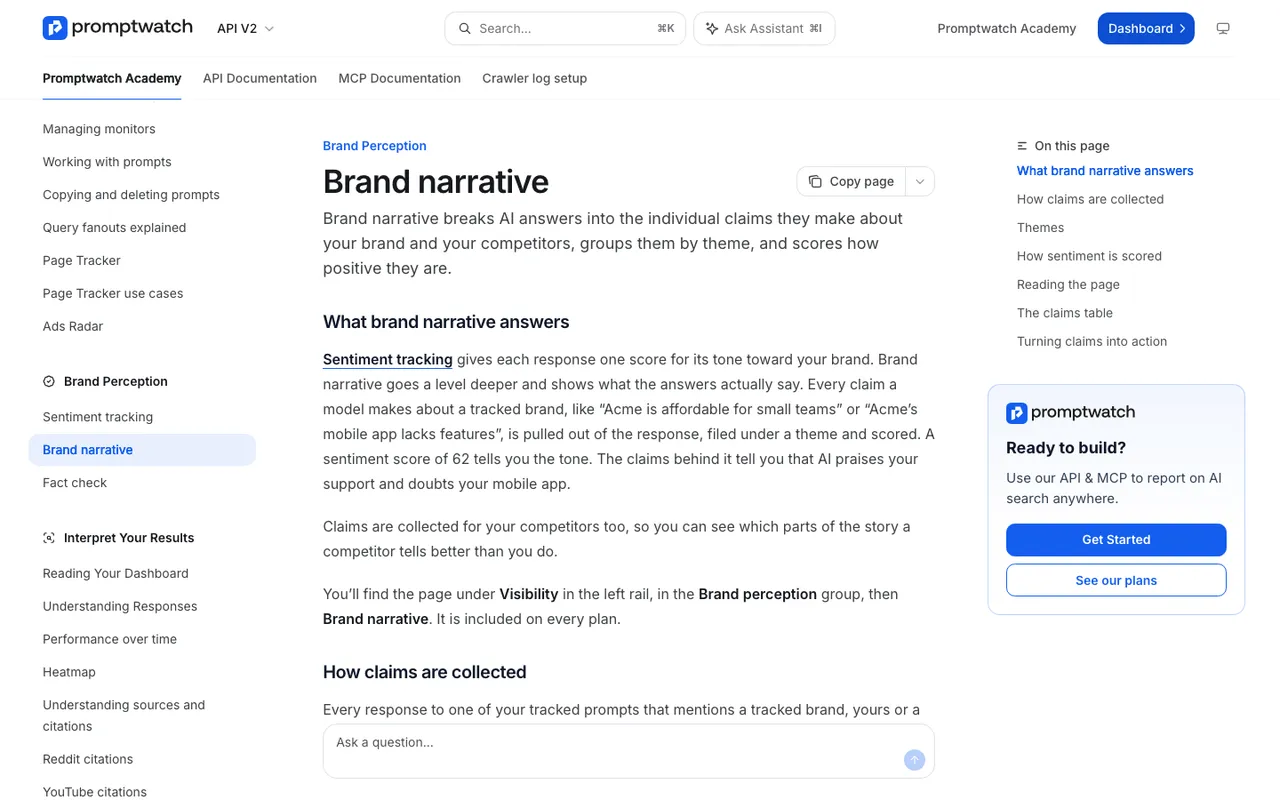 Promptwatch Academy's Brand narrative page, captured November 14, 2026.
Each grouped claim lands under one of nine themes: Pricing, Features, Quality, Usability, Range, Support, Reputation, Audience, and Company. Those themes map neatly onto the association types above. Audience labels sit under Audience, effort labels under Usability, gap labels under Features.
Brand Narrative is on every Promptwatch plan, so this doesn't depend on which tier you're on.
Reading the tone of each association
Every quote gets a sentiment score from 0 to 100. Below 40 counts as negative, 60 and up as positive, anything in between as neutral. A grouped claim takes the average of its quotes, and it's labelled Mixed when its quotes fall into more than one band. A theme's score is the average of every quote in that theme for one brand, so a claim engines repeat often weighs more than one they made once. Fifty is neutral.
The response-level sentiment score works the same way in principle. The Academy's sentiment page spells out what moves it: recommendations and praise push it up, factual mentions without judgment sit around 50, and criticism or caveats pull it down. "Works but has important limitations" lands in the low 40s.
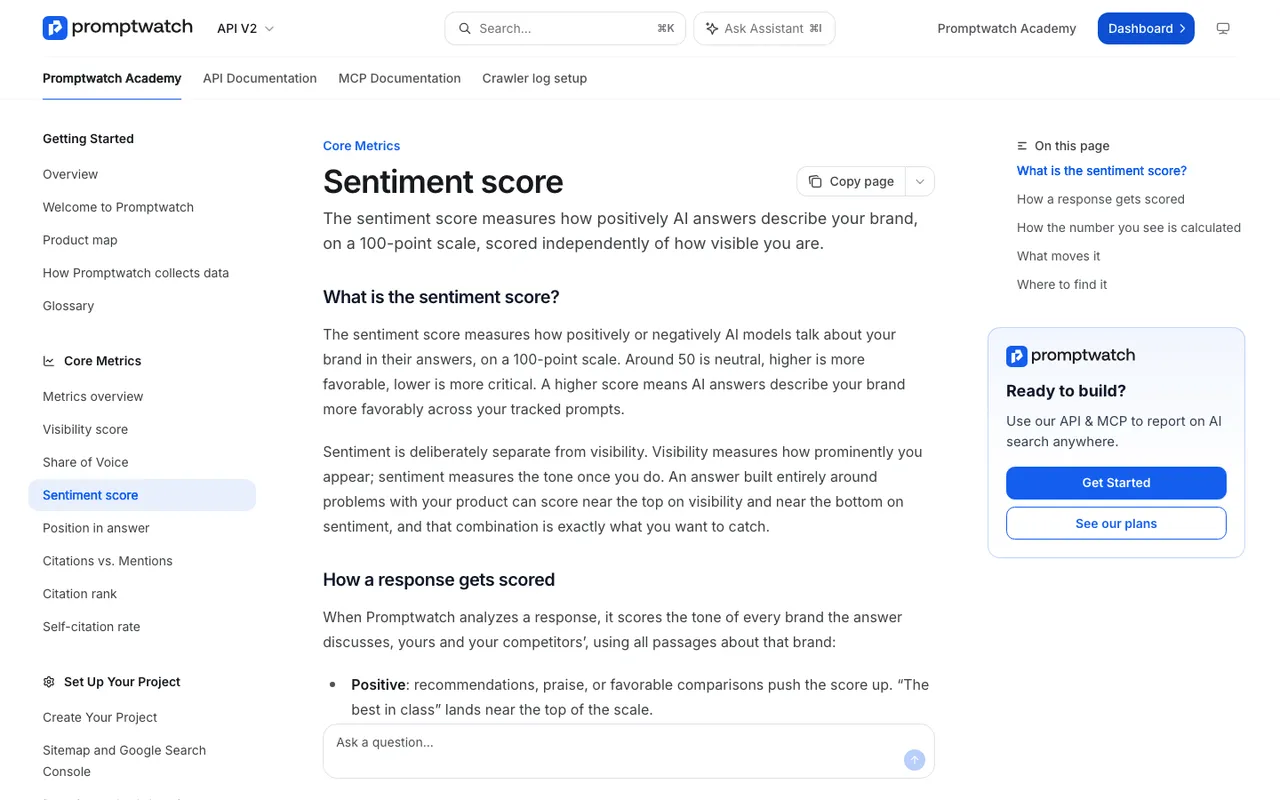 Promptwatch Academy's Sentiment score page, captured November 14, 2026.
Two reading habits help. First, watch the Mixed label. A claim like "easy to start with, but limited later" averages to neutral and hides both halves; expand the row and read the quotes. Second, remember that thin mentions aren't scored. If your brand appears only as a name in a list, there's no association to read, which is its own finding: engines know you exist but have nothing to say about you.
Why associations travel from sources
Engines don't hold opinions about your brand. They repeat what they read. The Academy says this plainly about sentiment: third-party coverage such as reviews, comparison articles, Reddit threads, and support complaints is where models pick up caveats like "their API is limited". It also notes that models repeat specific criticism long after you fix the issue.
That's why associations are sticky. A comparison article from two years ago that called you "hard to set up" keeps getting retrieved for setup questions. Your new onboarding flow doesn't appear in it. Until something the engine retrieves says otherwise, the old label stays.
In Brand Narrative, each claim has a Citations tab listing the pages the responses cited alongside it. A cited page isn't necessarily where the claim came from, as the Academy points out, but it's the first place to look. When we trace an association, we open those pages and search them for the wording. More often than not, the phrase is there, or something close to it.
Shifting an association you don't want
This is where we're careful with clients about what's possible. You can change what engines read. You can't change what they say directly, and you can't remove an accurate criticism by writing around it.
The steps we follow:
- Decide whether the label is wrong, outdated, or fair. Fair criticism goes to the product team. Wrong or outdated labels are content work. For a wrong factual claim about your own brand, Fact Check (on Business, Agency Scale, and Enterprise) shows whether your own site or the cited pages are the source.
- State the replacement association in plain words on your own pages. If engines say "for small teams" and you now serve mid-size companies too, a page needs to say who you serve, specifically. Vague copy doesn't compete with a concrete phrase.
- Don't repeat the old label to deny it. "Not just for small teams" pairs your name with "small teams" one more time. State the new fact instead.
- Work on the pages that carry the old label. For your own outdated pages, Content Refresh rewrites them against a tracked prompt. For third-party pages, ask for a correction with the exact sentence and your evidence.
- Give engines fresh sources to retrieve. Updated comparison pages, documentation, and case material that states the new facts give retrieval something newer to find.
Checking whether it moved
Set Brand Narrative's date range to the weeks after a change and watch the grouped claim. Is it repeated less often? By fewer models? Has a new claim appeared under the same theme with the wording you wanted? Then check the theme score against competitors in the Benchmark view, which shows your rank per theme and the gap to the best competitor.
We don't promise a timeline for this. Engines that search before answering can only reflect a changed page after they retrieve it, and models answering from training data won't change until they're retrained. Our post on reading sentiment in AI answers covers how to separate noise from a real shift.
A simple monthly association review
Open Brand Narrative, filter to your brand, and read the five most repeated claims per theme. Write down which ones you'd want a buyer to hear and which you wouldn't. Compare with last month. That one page of notes, kept over time, tells you more about how AI sees your brand than any single score.
If you want to see which words engines attach to your brand right now, start a 7-day free trial and open Brand Narrative once your first prompts have run. It's on every plan, so the entry-level Essential plan is enough to start.