AI brand perception terms, defined in plain language
Sentiment, theme score, claim, position, share of voice, self-citation rate, fan-out, accuracy score: the AI brand perception terms we use with clients, defined plainly.
Client kickoffs tend to hit the same snag early on. Someone says "our sentiment is fine" and someone else says "but our share of voice dropped", and it turns out they're talking about different things with different numbers. This glossary is the page we now send before the first meeting.
It covers the terms we use for AI brand perception, meaning what AI engines say about a brand when asked, as opposed to whether they mention it at all. Definitions follow how Promptwatch measures each one, since that's the platform we run client programs on, and each entry ends with a practical note on how we use it.
The two ideas everything else rests on
AI visibility
Whether, how often, and how prominently AI engines name your brand in answers to the prompts you care about. Visibility is about presence.
In practice: visibility gets you onto the shortlist. It says nothing about what the answer says once you're on it.
AI brand perception
What AI engines say about your brand when they do name you: the attributes they attach, the claims they repeat, who they say you're for, how they frame you against alternatives, and the tone they use.
In practice: we keep these two strictly apart in reporting. A brand can be highly visible and described badly, and that combination is the one that costs deals while the dashboard looks fine.
Building blocks
Mention
Your brand named in the text of an AI answer.
In practice: a mention can be the headline recommendation or a name in a list of eight. Counting mentions alone treats those the same.
Citation
A URL the AI attached to its answer as a source.
In practice: mentions and citations are recorded separately and improve through different work. Promptwatch's Academy puts it as mentions improving through reputation and citations through content on your own domain. For perception, citations tell you which pages the description was built from.
Claim
A specific statement an AI answer makes about a brand, such as "affordable for small teams" or "its mobile app lacks features". In Promptwatch's Brand Narrative, a claim is kept only if it's a verbatim quote of at least four words from the response, about a brand you track. Different wordings of the same point are grouped into one claim, with counts for how often it's repeated and which models say it. Claims that state a price are dropped.
In practice: claims are the most useful unit in perception work, because they're specific enough to trace and fix. "Sentiment is 55" isn't actionable. "Three models say we have no API" is.
Theme
The category a claim belongs to. Brand Narrative uses nine: Pricing, Features, Quality, Usability, Range, Support, Reputation, Audience, and Company.
In practice: themes map to owners. Pricing goes to whoever runs pricing, Features and Usability to product marketing, Support to the support lead. That makes it clear who acts on what.
Tone
Sentiment score
How positively AI answers describe your brand, on a 100-point scale where about 50 is neutral. It's scored independently of visibility, so being named first doesn't raise it. Mentions too thin to judge, like a bare name in a list, get no score rather than a neutral one.
In practice: investigate movement, not levels. A stable score is a fact about your brand; a sudden drop is an event with a cause, usually a new source the engines started reading. Comparison prompts tend to score lower than informational ones, so filter by prompt type before comparing.
Theme score
The average sentiment of every quote in one theme for one brand, from 0 to 100, with 50 as neutral. Individual quotes below 40 count as negative and 60 and up as positive.
In practice: compare theme scores against competitors, not against an ideal. Brand Narrative's Benchmark view shows your rank per theme and the gap to the best competitor, which tells you which part of the story a rival tells better.
Mixed claim
A grouped claim whose quotes fall into more than one sentiment band.
In practice: always expand these. "Easy to start, but limited later" averages to neutral and hides two separate messages.
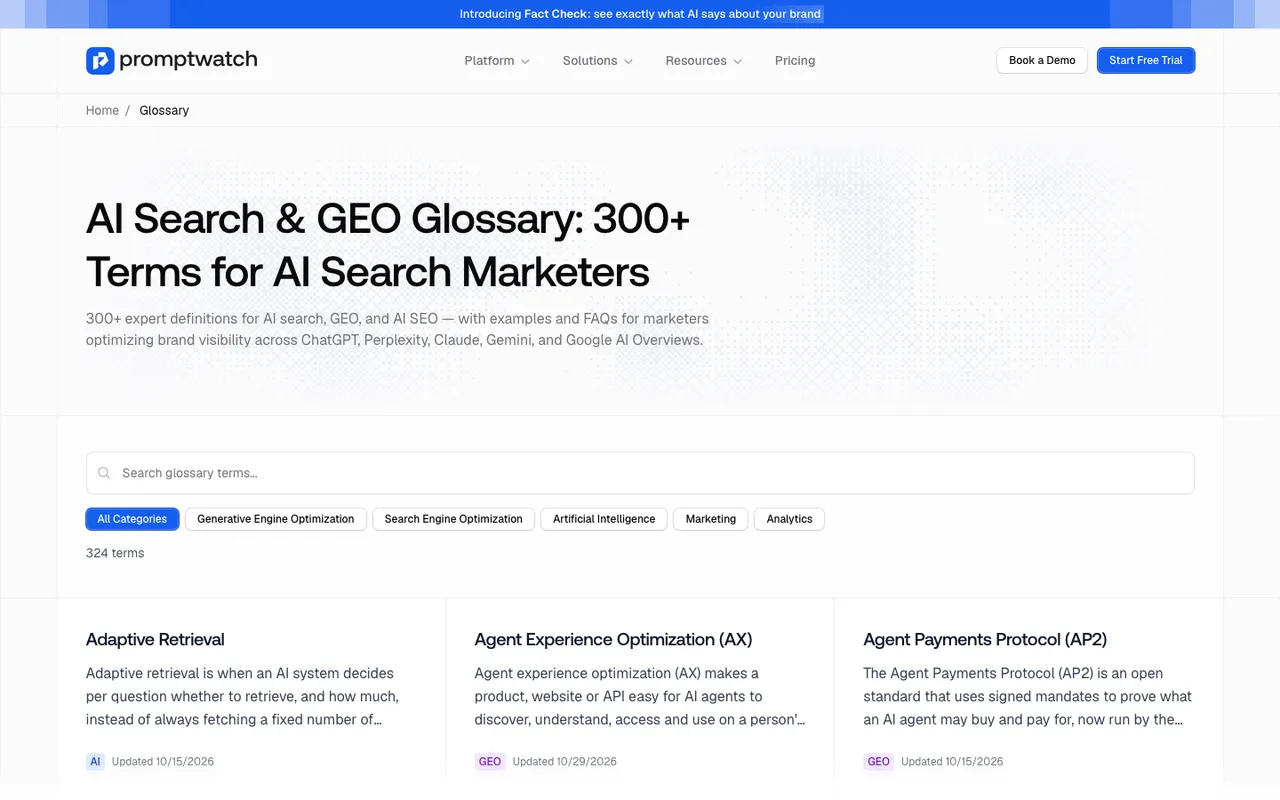 Promptwatch's AI Search and GEO glossary, captured November 14, 2026.
Promptwatch keeps a much larger glossary of AI search terms, shown above, if you need definitions beyond perception.
Presence and prominence
Visibility Score
How prominently your brand appears in answers to your tracked prompts, from 0 to 100. Each response is scored on placement, share of attention, and depth, then averaged, with responses that leave you out counting as zero.
In practice: the single number that reflects both how often and how well you appear. Use it as the headline, then explain it with the metrics below.
Share of Voice
Your slice of all brand mentions in the current filters, counted as one mention per brand per response.
In practice: it depends on who's in the comparison. Adding a competitor to your list adds their mentions to the denominator. Keep the list to brands you actually compete with.
Position
Where your brand first appears in the order of brands within an answer, counted from 1, averaged across responses that mention you. Lower is better.
In practice: position is perception-adjacent. Being named first often comes with being framed as the default; being named fifth often comes with "also consider".
Sources
Citation rank
When an answer cites your own domain, where that citation lands in the source list, counted from 1.
In practice: closer to 1 means your page is becoming a primary source rather than a supporting one.
Self-citation rate
The share of all citations in your tracked answers that point at your own domain rather than third-party pages.
In practice: this tells you whose words describe you. High means updating your site updates the source. Low means the description comes from review sites, comparisons, and forums. Branded prompts self-cite much more than category prompts, so filter by prompt type before reading a trend.
Citation Share
On Promptwatch's Topics page, the citations of your own sites divided by all citations in a topic's answers.
In practice: the topic-level version of self-citation, useful for tracking whether a launch or a content push is making engines build answers in that topic from your pages.
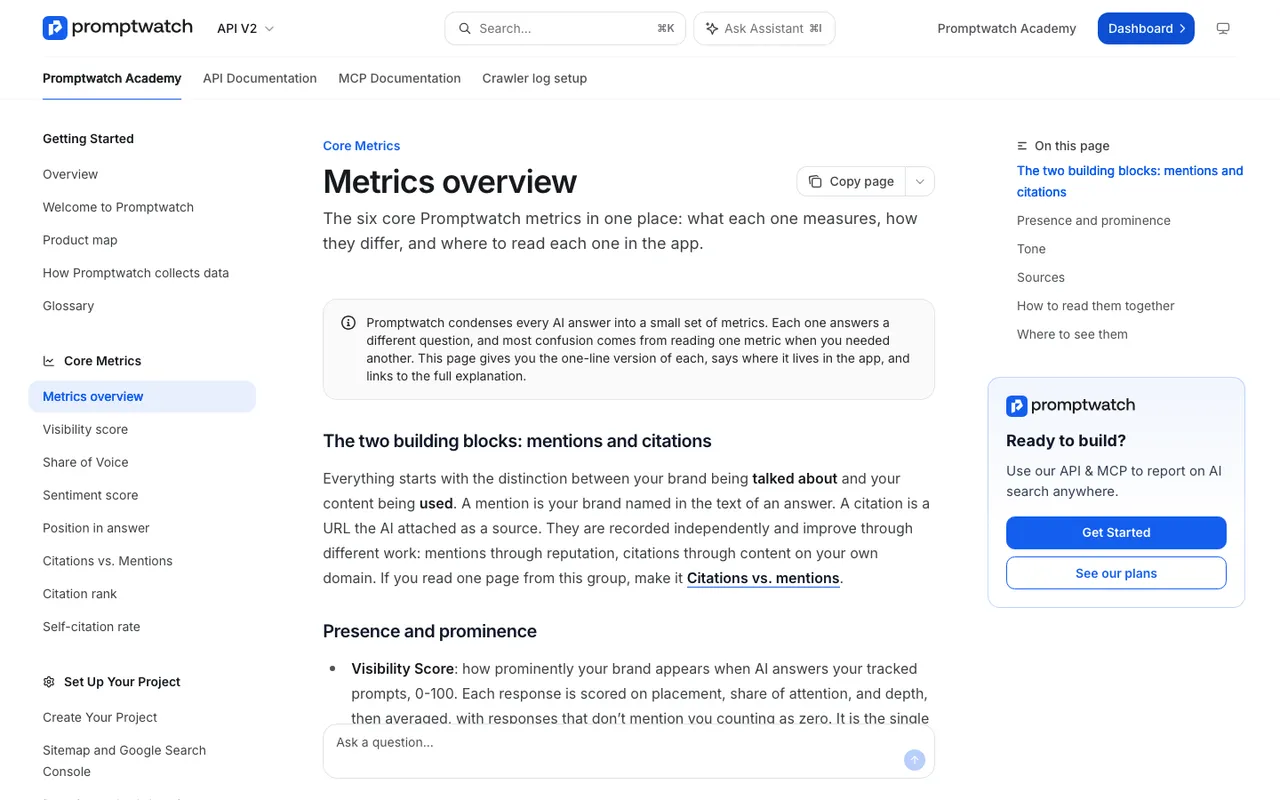 Promptwatch Academy's Metrics overview page, captured November 14, 2026.
How the answer gets built
Query fan-out
The searches an AI engine runs on its own behind a single prompt. A question about your brand might be split into sub-queries about reviews, pricing, or a competitor comparison.
In practice: fan-outs decide which pages get retrieved, and the pages carry the adjectives. If an engine searches "[your brand] problems", the pages that rank for that search will shape the tone. Promptwatch records fan-outs per model for tracked prompts, and its free GEO Inspector extension shows them live in ChatGPT.
Fetched versus cited
A fetched page was read by the engine while answering. A cited page was attached to the answer as a source. Not everything fetched gets cited.
In practice: a page of yours that's fetched but not cited was read and passed over. That's a content problem on a page you control.
Citation crawl
In Promptwatch's crawler logs, a request from a bot fetching a page while answering a user, such as ChatGPT-User. Since November 4, 2026, search indexers such as OAI-SearchBot are counted as AI crawls instead.
In practice: citation crawls are the closest you get to watching an answer about you being assembled. Crawler logs start on Promptwatch's Professional plan.
Accuracy
Fact Check outcome
The result of checking a claim about your brand against your own pages and up to 50 of the most-cited pages AI used. Five outcomes: Confirmed, Leans confirmed, Conflicting, Leans conflicting, and Inconclusive.
In practice: a check reports what pages say, not what is true. If your own old blog post states the wrong thing, the check will confirm it. Fact Check is on Business, Agency Scale, and Enterprise.
Accuracy score
The share of your brand's checked mentions that are accurate, from 0 to 100. Your own mark on a claim wins; otherwise the latest finished check decides. Inconclusive and unchecked claims don't count, and every repeat of a claim counts as a mention.
In practice: keep the set of checked claims fixed when comparing periods. Checking a new batch of claims can move the score without any AI answer changing.
One term we avoid
"AI ranking". Clients use it, and we understand why, but AI answers don't have a rank in the way search results do. There's position within an answer, visibility across answers, and share of voice against competitors. Saying which one you mean saves a lot of confusion later.
If you want to see these numbers for your own brand, start a 7-day free trial. Brand Narrative and the core metrics are on every plan, so you can check the definitions against your own data in the first week.